Third Sex/Third Gender in Montenegro
Čarna Brković
Photo: Čarna Brković
I met Petar through a friend. He had kind blue eyes and a firm handshake. It was important to him to pay for my coffee, which I accepted the first few times. Once we became friends, I started arguing with him about it. Paying the bill was a point of contention for many men in Montenegro, for whom having enough money to spread around was a symbol of virility. Petar understood why, as a cis woman, I insisted on sharing the bill, although he continued wanting to pay for me. Both Petar and I knew that our gendered struggles were shared, if not necessarily the same.
Petar often talked about his family. One time, over our third beer, he told me about a visit to Father Joli, the famous seer.
“When my mother realized that me as a trans man was not a phase, she took me to a famous priest to ask for advice. We were supposed to go from my grandparents’ house in the north to her workplace in Podgorica, but she turned the car around and started driving to the Ćirilovac monastery near Kolašin. The ride lasted for hours.
When we approached Ćirilovac, I started laughing hysterically and endlessly. I remember my mom’s shocked gaze. I couldn’t determine whether she pitied or hated me. I blacked out.
The next thing I remember was a man in a long black robe, with a beard that I thought trailed behind him for kilometers. His eyes were terrifying. I was given the wrong vaccine at birth, he said. The vaccine had male hormones, which had caused everything I am today. They needed to baptize me urgently, before it was too late.”
Petar described what happened next as exorcism. Father Joil read a sermon, refrering to Petar as sick, wrong, and yearning for forgiveness. Petar’s lungs felt as if they were collapsing as he wondered whether there was a devil hidden inside him. “Quite possibly,” he thought, “it had been there since I came into existence.”
After this, we sat in silence for some time. The next day, I looked up Father Joil.
In 1991, as socialist Yugoslavia was falling apart and nationalist forces came to power, former chemistry professor Jošo Bulatović became Joil, a priest in the Serbian Orthodox Church. He built the Ćirilovac monastery deep in the woods on his family property and became known as a seer with strict views on family life. He even refused to give communion to smokers. Stories about Joil curing various spiritual and health problems were widely published in tabloids.
It was through tabloids that Joil became a famous figure in the market of family doubts.
Montenegrin families regularly turned to fortune tellers, priests, and hodžas for guidance when faced with an existential issue, such as child loss, the desire for children, drug abuse, adultery, abortion, or alcoholism, or seeking to navigate new and morally demanding situations. Fortune tellers and religious leaders provided seekers with new interpretative frameworks to understand and address their issue. The job was not so much to tell the future but to help make sense of the present. Petar’s mother sought such advisors to grapple with the question of why her kid transitioned and what it meant to be both “trans” and a “loving child” at the same time—or whether this was possible at all. To many, living as a trans person seemed selfish, like a betrayal or a slap in the face.
Joil’s advice to baptize Petar did not help him or his mother. For a while, her new husband demanded that Petar pray three times a day, holding an Orthodox prayer rope in his hands. Eventually, this too stopped. What ultimately made a difference was a visit to Agnesa, a nearby fortune teller, who declared that Petar was a sworn virgin.
Agnesa received seekers in her living room, before pouring lead for them. The pink walls were adorned with a large, round golden mirror, and roses were arranged carefully on the dining table. Visitors waited in the apartment hallway until they were invited inside, sitting on a few chairs beside a small table laid out with bonbons.
As soon as Petar and his mother quietly entered the room, Agnesa turned toward him and said: “I see you.” During their conversation, she explained that Petar was akin to an ostajnica (pronounced as ostainitza)—a sworn virgin, also known as burrnesha or tombelija—a person born a woman who assumes the social role of a man to protect the family. Petar’s transness, she suggested, was not an attack on the family. It was an attempt to defend it.
Upon hearing this, the mother felt as though a haze had been lifted from her eyes. Suddenly, everything made sense. Petar’s father had left her while she was pregnant. She had returned, ashamed, to her parents’ house. After remarrying, she had two more children, both girls. In a country where sons and daughters were legally entitled to inherit property yet in practice only sons usually did, having daughters posed a problem. It meant that the family’s name would not continue.
Being a boy, then, was Petar’s way of telling his mother he got her back, Agnesa suggested. Whatever might happen to her, however her husbands might treat her, he would be there to protect the family, its property, and its name. Agnesa helped them reinterpret Petar’s transness as selfless rather than selfish. He was building new relations for the sake of his family, not cutting them lose for individual gratification.
Petar was grateful for this interpretative intervention, even if it left him unsettled. He was not trans because of his mother, he thought. He was trans because he was a man. Petar appreciated being able to protect his mother in the way Agnesa described. Still, the urge to live as a man was lodged somewhere deeper within him. And besides, weren’t ostajnicas women who were pushed to live as men by the force of tradition?
According to the ethnographic sources, not necessarily. This local articulation of third sex/third gender was a constitutive element of the gender landscape in the mountainous parts of Montenegro, Kosovo, Albania, and Bosnia and Herzegovina at least since the 19th century. The last known ostajnica in Montenegro died in 2016, while several dozen still live in Albania. Ostajnica literally means “the one who stays,” referring to the fact that these persons did not marry nor follow the patrilocal pattern of women moving to the husband’s family household. They stayed at their parental household instead and took on the role of a man.
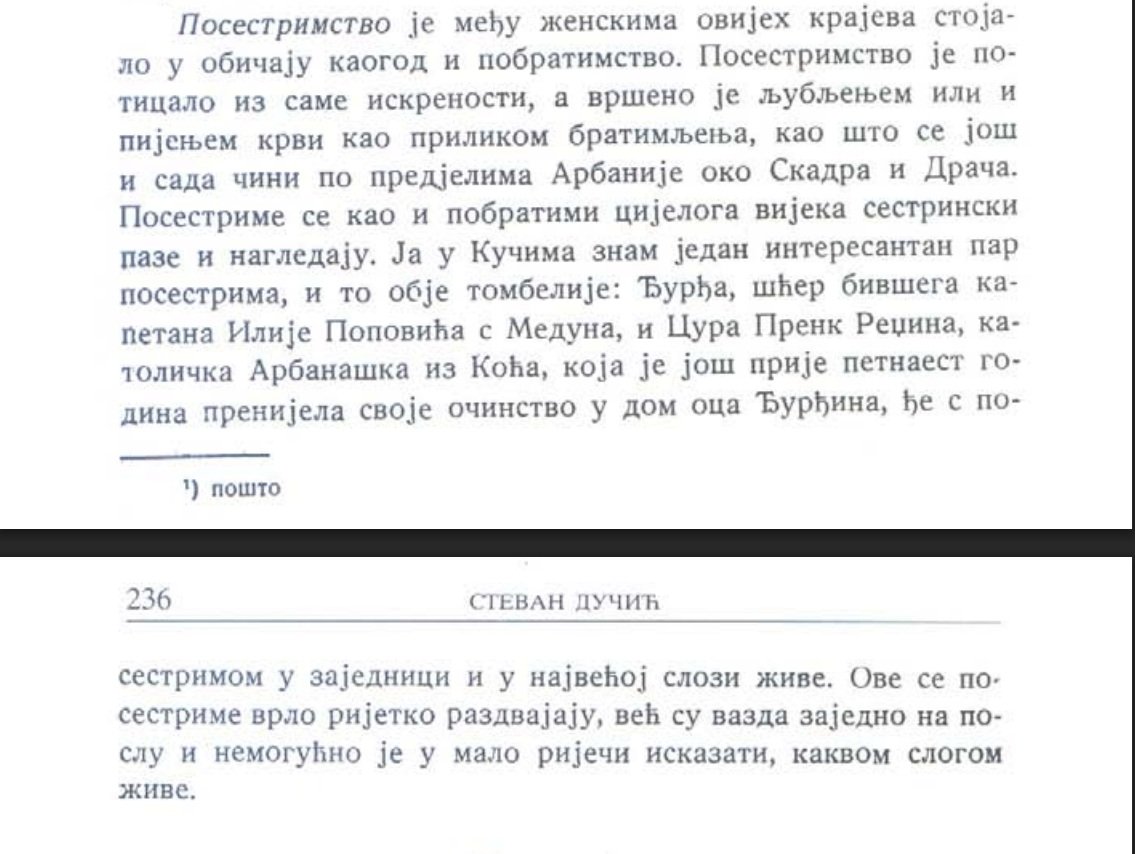
Ethnographer Stevan Dučić describes a family of two ostajnicas who lived in Montenegro in the early 20th century:
“In Kuči I know an interesting pair of sworn sisters, both of them tombeljijas: Đurđa, daughter of the former captain Ilija Popović from Medun, and Cura Prenk Recina, a Catholic Albanian woman from Koća, who fifteen years ago brought her dowry into the home of Đurđa’s father, and they live together with her sworn sister in the greatest harmony. These sworn sisters very rarely part from one another—they are always together at work, and it is impossible to put into words what unity they live in.”
The communities where ostajnica was recorded as a gender practice have little in common in terms of cultural identity. This practice is not linked to a particular religious identity, since it was documented among the Catholics, Muslims, and Orthodox Christians. Neither is it specific to a particular ethno-national identity; there were ostajnicas among people who described themselves as Montenegrins, Serbs, (Kosovar) Albanians, Bosniaks, and Roma.
However, there were some things that these diverse communities shared: the mode of subsistence and the family structure. Ostajnica was practiced predominantly among the pastoralist communities living in the mountains who developed patterns of large cooperative families. Survival in these communities before socialist modernization largely depended on the shared labor within a family. Property was also owned collectively by a family rather than by an individual. In the strict gender and age division of labor among the mountainous Balkan communities, an ostajnica performed the tasks reserved for adult men. They carried weapons, made decisions in the name of the household, engaged in difficult agricultural and/or cattle work, such as mowing, hay-stacking, ploughing, and harvesting, cattle-breeding, and so on. Often, but not always, they also dressed like men, smoked, and adopted a new, male-sounding name.
The English term “sworn virgin” is misleading. Although they never got married, we know that at least some of them had sexual experiences. The assumption of virginity reflects a heteronormative expectation that sex can take place only in a wedlock. There are records of people who became ostajnicas later in life, as divorced women. Rene Grémaux’s research suggests that some ostajnicas expressed sexual desire towards women and that sometimes the fellow villagers assumed that an ostajnica and a woman they lived with were “lesbians.” While an ostajnica was prohibited from marrying or having children, the terms we use should leave room for at least the possibility that some of these people had some sort of sexual experiences.
There was no strict code of conduct that prescribed when a person would present themselves to others as an ostajnica. Becoming an ostajnica was one option on the people’s horizon of possibilities, including lack of a male heir, death of the head of the household, refusal to marry, severing an engagement, getting a divorce, and so on. There are accounts of people who willingly chose to become an ostajnica as adults as well as of people who were raised as ostajnicas from early childhood. In conversations with the living burrnesha in contemporary Albania, Martinez writes they usually said they had lived as boys as long as they could remember, and out of personal desire.
Ostajnicas were not rebels against heteronormativity; they firmly inscribed themselves into the dominant gender landscape. In doing so, they also destabilized gender as a category. Ostajnicas did not simply suffer under the cruelty of patriarchal tradition. They were also not quite figures embodying sexual or gender liberation that LGBTIQ activists could celebrate today as unambivalent forebearers of trans identity. Ostajnicas represent a non-binary as well as a patriarchal practice of gender, premised upon sustaining a gendered landscape in which femininity was strongly devalued, both symbolically and materially. The mountainous Balkan communities included a place to articulate gender that both confirmed and overcame the heteronormative binary.
Some trans and queer people from the Balkans seek ways to establish connections with the heritage of ostajnica. Others “are repulsed by everything traditional—precisely because they link the traditional with transphobia and homophobia—so they do not invest themselves in gaining this kind of knowledge,” according to Jovan Džoli Ulićević.
My friendship with Petar taught me that a conversation on queering Balkan traditions is vitally needed, as difficult as it may be. The challenge is to disrupt the narrative that alternative expressions of gender and sexuality are foreign and imposed to the Balkan societies from the West without falling into a trap of misreading those traditions or claiming cultural specificity through the lens of identity politics.

Several weeks after visiting Agnesa, Petar and his girlfriend, a trans woman named Mima, rented a new apartment at the center of Podgorica. They bought dozens of flowerpots, two huge Great Danes, and created a small wonder. Their apartment soon became a space for trans-healing, self-care, and divination. Guests came in unannounced and stayed for hours, cooking meals independently and reading future from the coffee grounds. When I visited, we would often open tarot; I had all kinds of questions about the future. Career decisions, workplace issues, love quarrels, friendship betrayals. No topic was off-limits in their green nest in which labor, rituals, and the minutiae of everyday life were shared.
Once, we invited spirits to join us. Petar wanted to thank his recently deceased grandfather for the change in the family. After visiting Agnesa, the pressure waned, and the grandparents even promised he would inherit one part of the family house.
Once he arrived, Petar’s grandfather was in a good mood. He spoke to us through a spirit board, asking whether the same political party was still in power. He was glad that Petar was going to inherit the house, too. He was curious about the car that Petar’s uncle bought. And then he said Mima’s grandfather was next to him.
The air in the room changed. Mima’s gaze hardened. She said in a deep, careful voice: “Do not invite him. There are no sworn virgins for me,” and left the room. Petar run after her. The rest of us in the room with the spirits could hear them arguing, crying, and then whispering. After some time, we quietly left the apartment.
Next time I met her, I asked Mima what she meant by her comment. Trans men had sworn virgins as a tradition to turn to, she said. For many it did not work, but for some it did, like for Petar. There was no such interpretive device for trans women. No traditional practice, way of being, not even a ritual to turn to. “What person in their sane mind would want to be a woman?” she asked.
This is a para-ethnographic story: a fictionalized account based on insights gained during 2022/2023 ethnographic research with trans communities in Montenegro.