A Piece of Bread
Lisa Alexandrin
This is my dad's story about growing up in Pančevo, coming to Canada, and losing all his memories. Some time between 1947 and 1950, my dad, his parents, and his grandmother were deported from Belgrade, Yugoslavia, to a DP camp in Trieste.
Across the generations, my dad’s family learned many languages. Sometimes but not always these were the language of empire, the better to tell lies and to keep secrets. Learning the languages of empire was to hide and survive. There were also languages of emotions, spirit, and joy.
Across the generations, my family would remember again who we were and where we came from because of our deep ties with the Kalmyk community.
This is only part of a larger story. Now is as good time as any to mention that in my family, our tradition is always to tell each other's stories but not our own, and this is the way it has always been. I think this way of relating and telling and listening was born out of wanting to preserve a silence deeper than stone and to keep in place the heavy grief of loss that still burns too hot.
I know many of these stories, because I was told to listen and remember them all. My memory was a gift to my dad's family, until I wanted to ask questions. Sometimes I had too many questions, and my dad would get upset. Then he would write me letters during his breaks between teaching his classes and mail them to me in Boston. My dad would write:
I am sorry I have nothing to leave you but what my father taught me, to have faith and to learn to stand like a human being. I hope you go through all of your life and never have to put your hand out, asking for a piece of bread.
Sometimes the letters were like this:
Alexandrins lived on a steppe big enough to raise all the tabun horses the Tsar's army could ever want. The gods were happy and the sun shined. Then bad times came, and we lost all of our memories, even of who we were.
I was nineteen.
After my dad's death, I displaced my fears and anxieties connected to this family amnesia of who we were and where we came from onto a postcard of Trieste I found tucked away in an envelope of family photos.
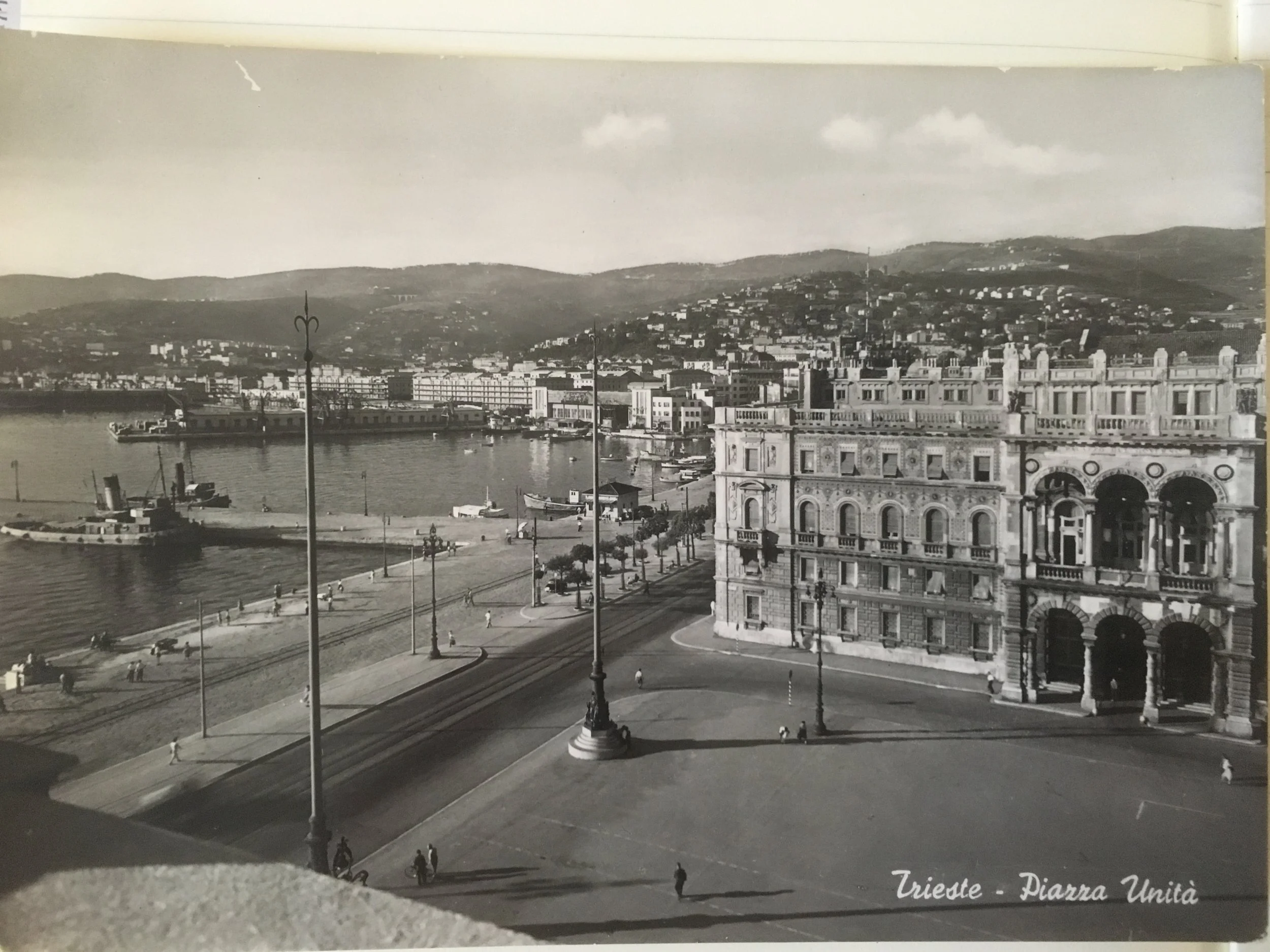
I guess this was the best I could do at the time so that I didn't spend more time ruminating about immense loss that swept up together not only my dad's death but my mom's of cancer.
Holding onto that postcard from Trieste, I can still hear my grandmother's prayers over the phone, may God protect us. God protects us. We are under His protection (from the years 1993 to 1995). Looking at this postcard, I remember the Serbo-Croatian, Russian, and Bosnian books my dad threw away, in speechless grief (during the spring and summer of 1994). I remember his declining years and dementia (from 2006 to 2016), his insistence on speaking Bosnian to me in the last two years of his life, reminding me not to forget recent Canadian legislation like Bill C-51 would concern us in terms of keeping citizenship in Canada. I remember his death, days before Trump was elected US President in 2016, and the rows of empty vodka bottles my stepmother and I found in the closets when I helped her move out of their apartment in 2017.
After my dad's passing, I rushed to save all the family photos from being thrown out by my stepmom and to take them to my home. Sometimes I try to write stories around these photos. I wonder about the waters of memory that flow between my fingers and think about how, in the late 1960s, my grandmother went back to her father’s house in Belgrade. The people living there gave her a blue suitcase of the family photos, including those of family that stayed in Grozny and maybe even Ossetia, or Circassia. I don’t know for sure. My dad never went back, but he kept these photos. I like to think that he kept them safe for me, all in brown envelopes, labeled according to time and place.
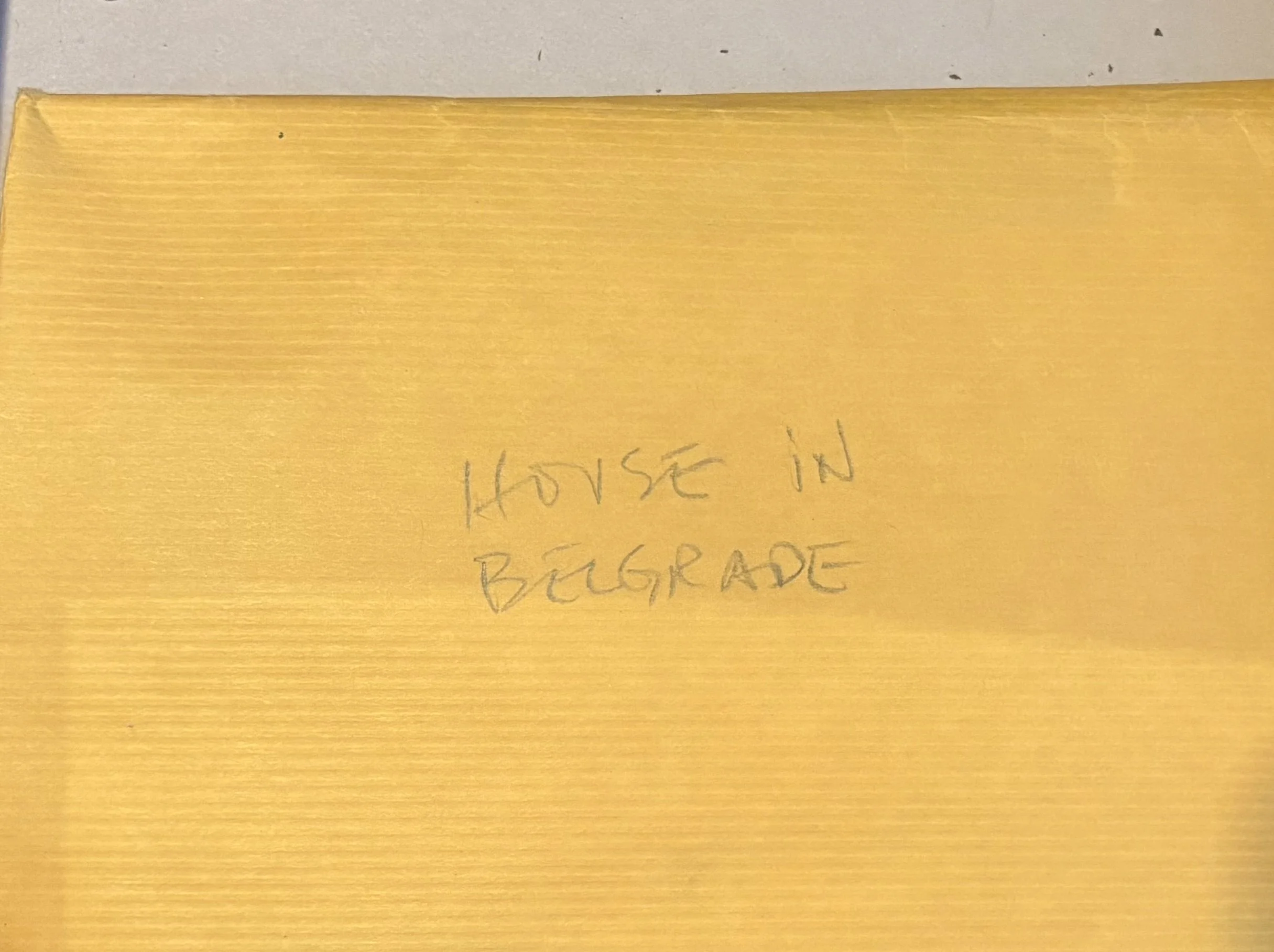
The photos I am about to share are stacked together in two such envelopes. One is “House in Belgrade,” the other, “photo” (фото). In 2005, when he was diagnosed with dementia following a major heart surgery, my dad added rubber bands to close shut the envelopes and placed everything in a grocery bag from a store on Market Street in Philadelphia, where you can buy the best fish.
When you open up everything, put the rubber bands to the side, and start to go through the photos, layer by layer, they look something like this.
I saw the first photo in the stack when I was very young. I asked my dad why my great grandmother's hair was so white. If I retell the story my dad told me, it goes something like this:
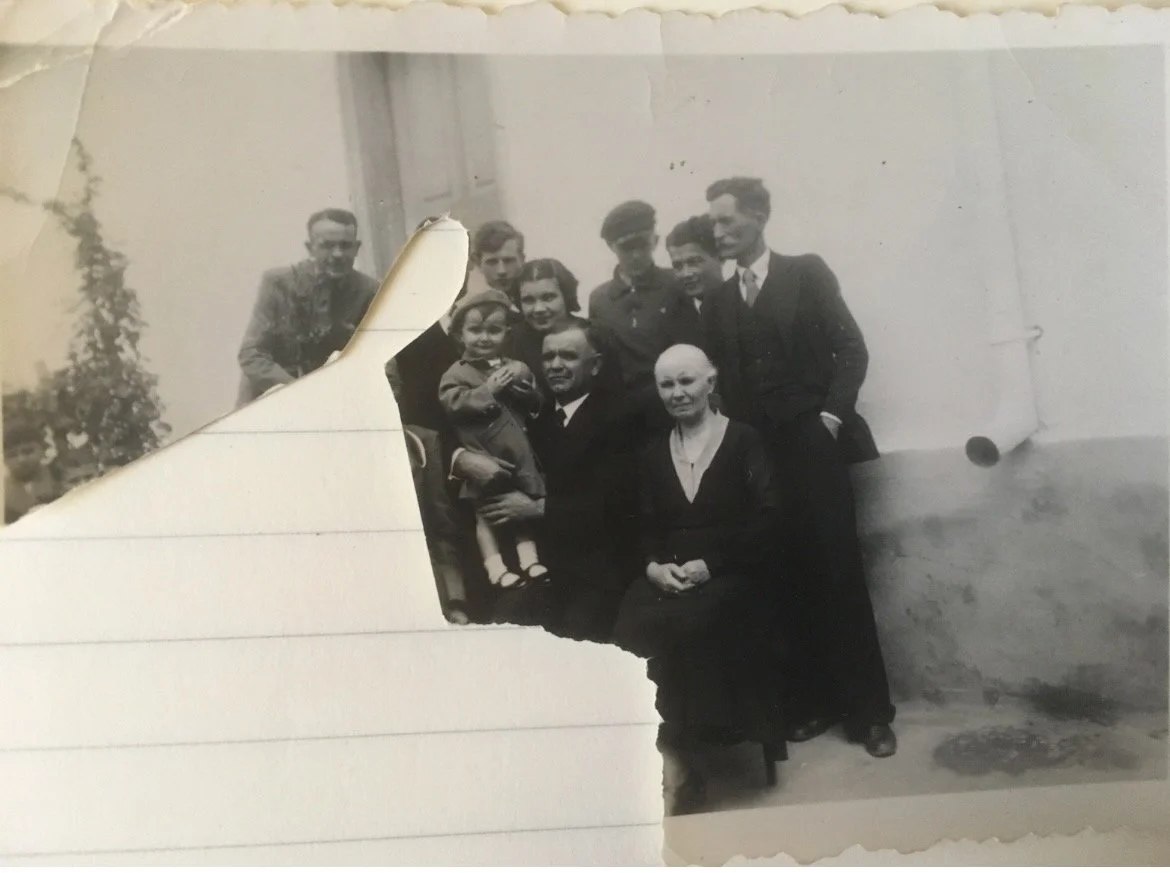
Here is my family in 1939. My dad wears a little brown hat. He is dressed up like a gum drop, which he likes a lot, but his socks always fall down. He is sitting with my great grandfather, my great grandmother, my great uncle, who had an antique store in Sarajevo and died of TB, and close family friends. They are in the court yard that connects together my great grandfather's home and bakery. My grandfather has been cut out of the photo, along with one other person, whose name we can't mention in public, but my grandfather's best friend from his school years in Goražde stands in the back row, second to the right.
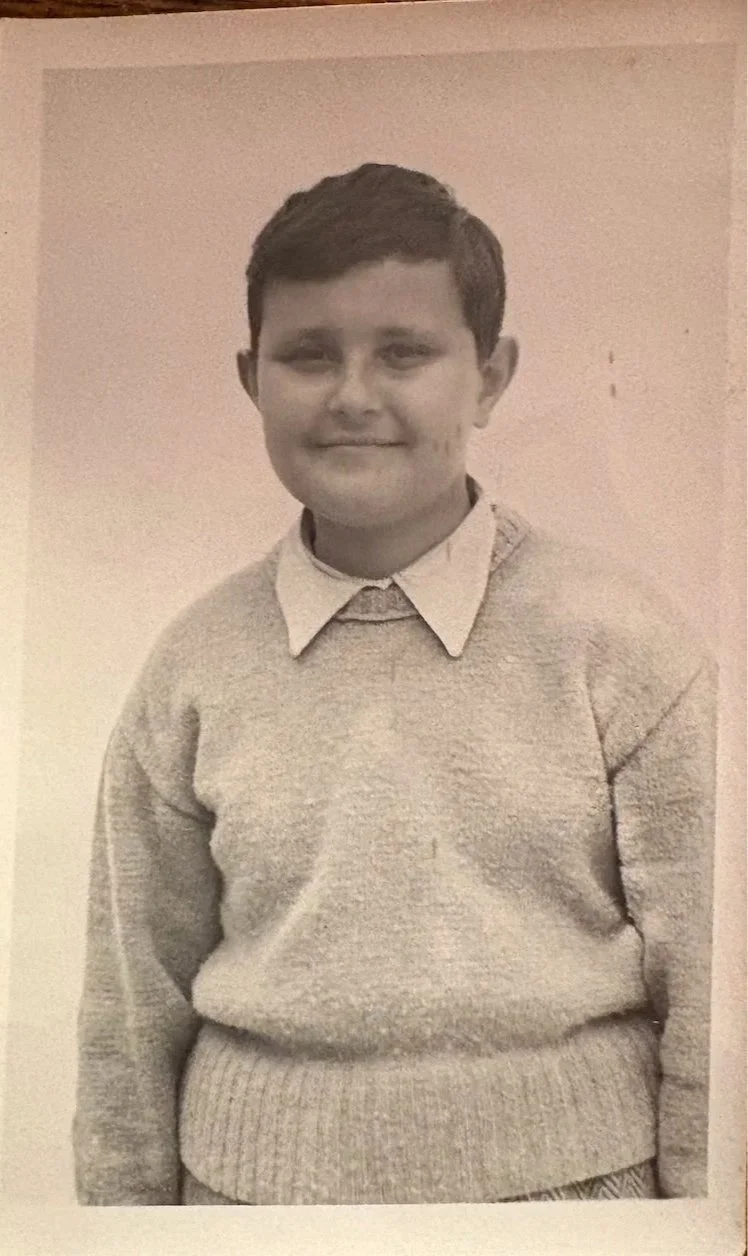
Then there's this photo of my dad in Trieste. He is very sad but trying hard to smile. I first saw this photo in 2017.
Sometimes my dad would tell me a story that he remembered he had to sign a form giving up his Yugoslav citizenship when he was fifteen and in the camp.
I don't know if this is true.
He would always mention this part of the story after saying that he was told to leave his school and was not allowed to return. He thought he was expelled because he had sat on top of a desk and kicked a chair with his feet. When he was swinging his legs, he was blamed for destroying property of the state of Yugoslavia.
Is that how it happened? Who was to blame? These were the memories of a child, shared with me when I was a child.
A heavy burden.
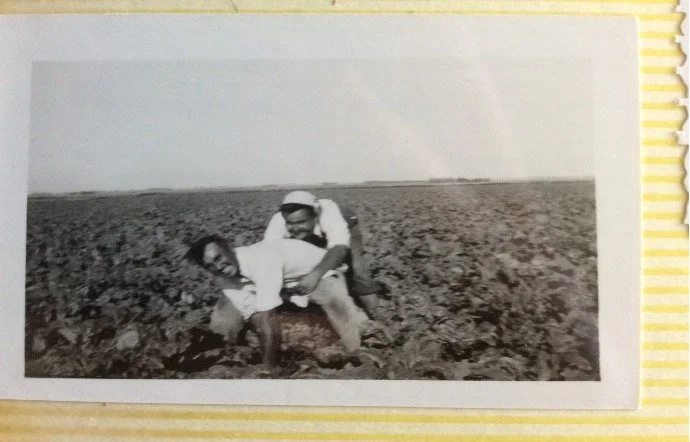
And then, last in the stack of photos are several of the Sugar Beet Farm in Alberta. This is a photo of my dad (in the white hat) and my grandfather.
Cast like a small stone, Aleksandrins left Trieste, and landed across the ocean, at a distant shore. Here is happiness and some kind of joy, if only for a moment.
This is how my dad’s family stories, like water, wash up on the shore and tides pull them away.
Then, one day in October 2024, I was on my way back home after teaching, and finally got off at Plaza Station to look at the public art installation I had been consciously avoiding for years. I thought to myself, this public art installation tells me a story that I recognize about the hard labor of picking sugar beets, like my dad's family did when they had to leave Yugoslavia and came to Canada. It is about me, yet not about me at all. I decided to find archival documentation connecting my dad's family's deportation from Yugoslavia, and how they then became one of the "Sugar Beet Families" sent to Canada. This, I decided, I could do. I went into the archives and started reading. Reading is something I can do.
I know the family wounds encircle what nourishes my lived experience and current academic life. That's another story. Now I am thankful that I found a home in Manitoba, where there are spaces for me to remember and where all of us can learn to remember our stories again. I am grateful for people in the online group Kalmyk Road, who knew my dad's family and who helped me to learn how we came to Canada, from Trieste, Belgrade, and Istanbul. It started with a photo from a Buddhist Maitreya festival in New Jersey, showing my older brother with a Kalmyk elder, Sandow, who knew my great grandfather, Zahar, from all the way back in Don-Volga.
Here’s what I found in the archives. Without Sandow's name, I would not have found anything at all.
Marcenkovs and Aleksandrins! Our very own archival family tree!
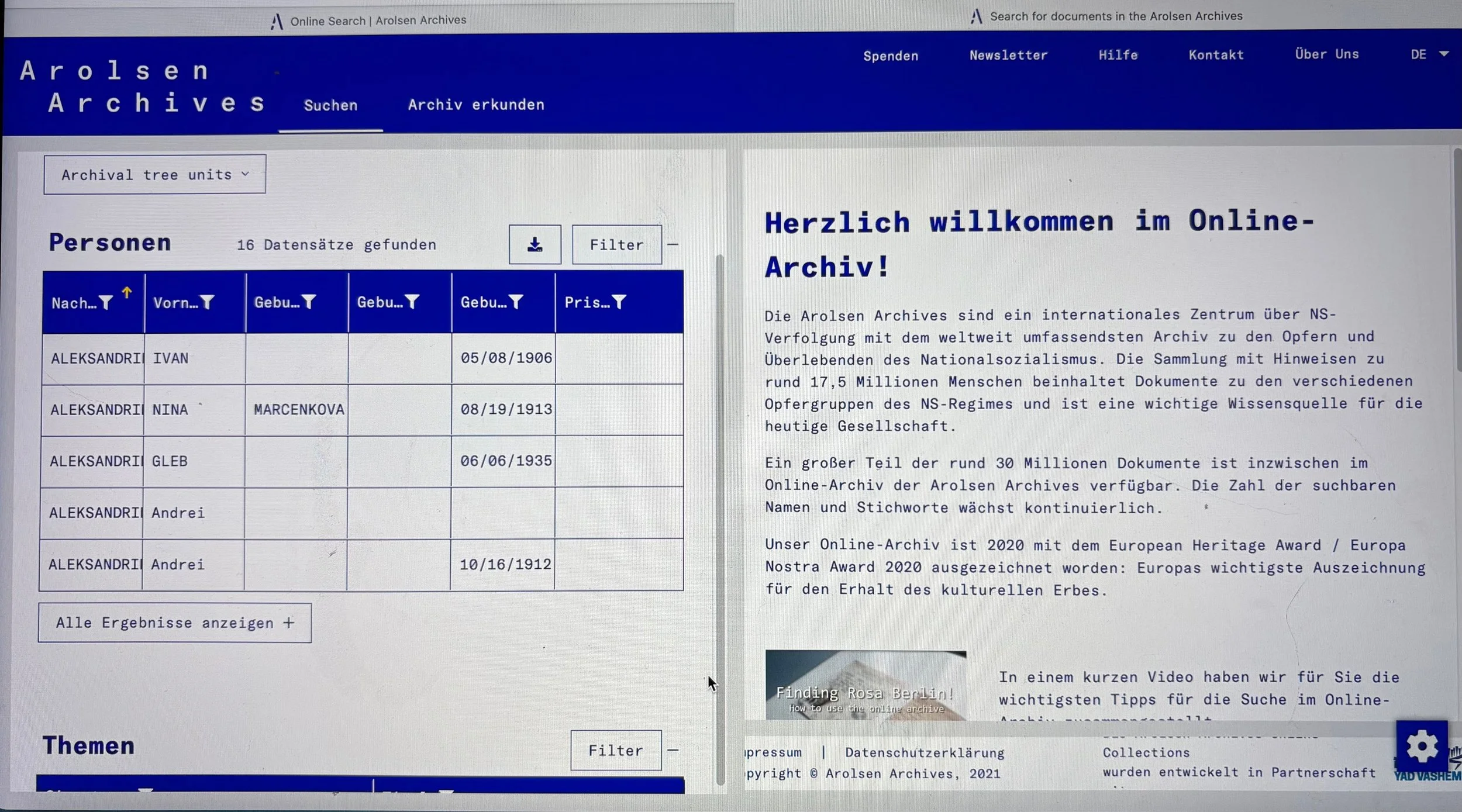
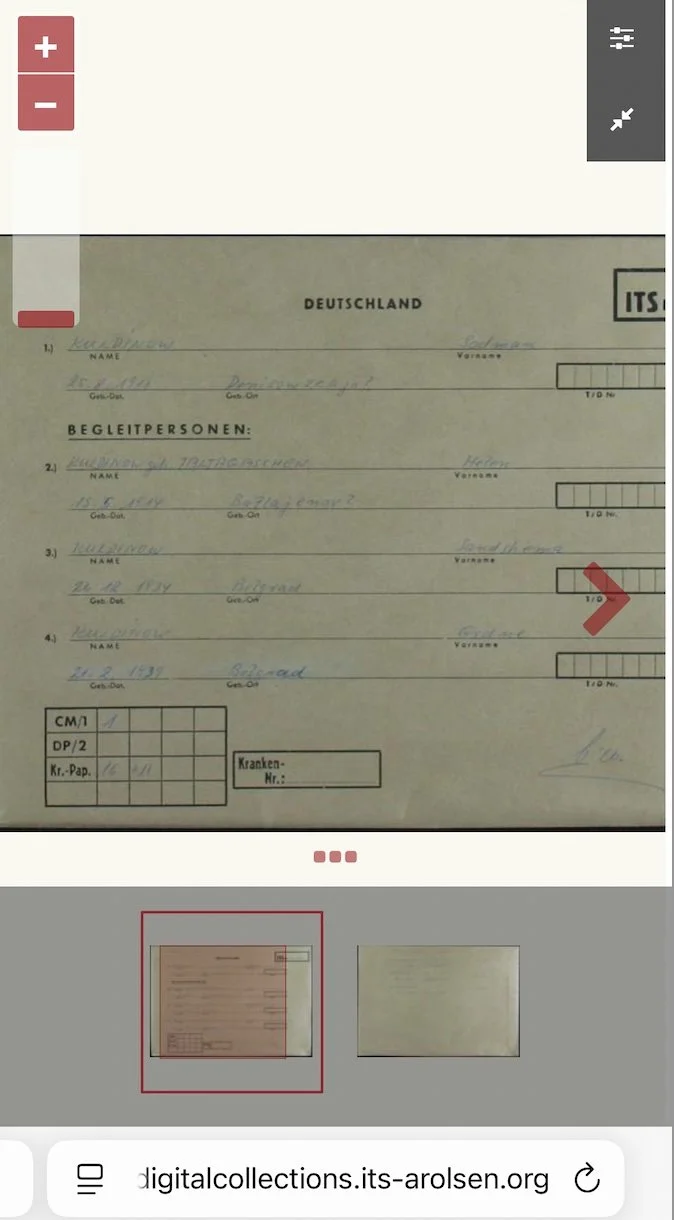
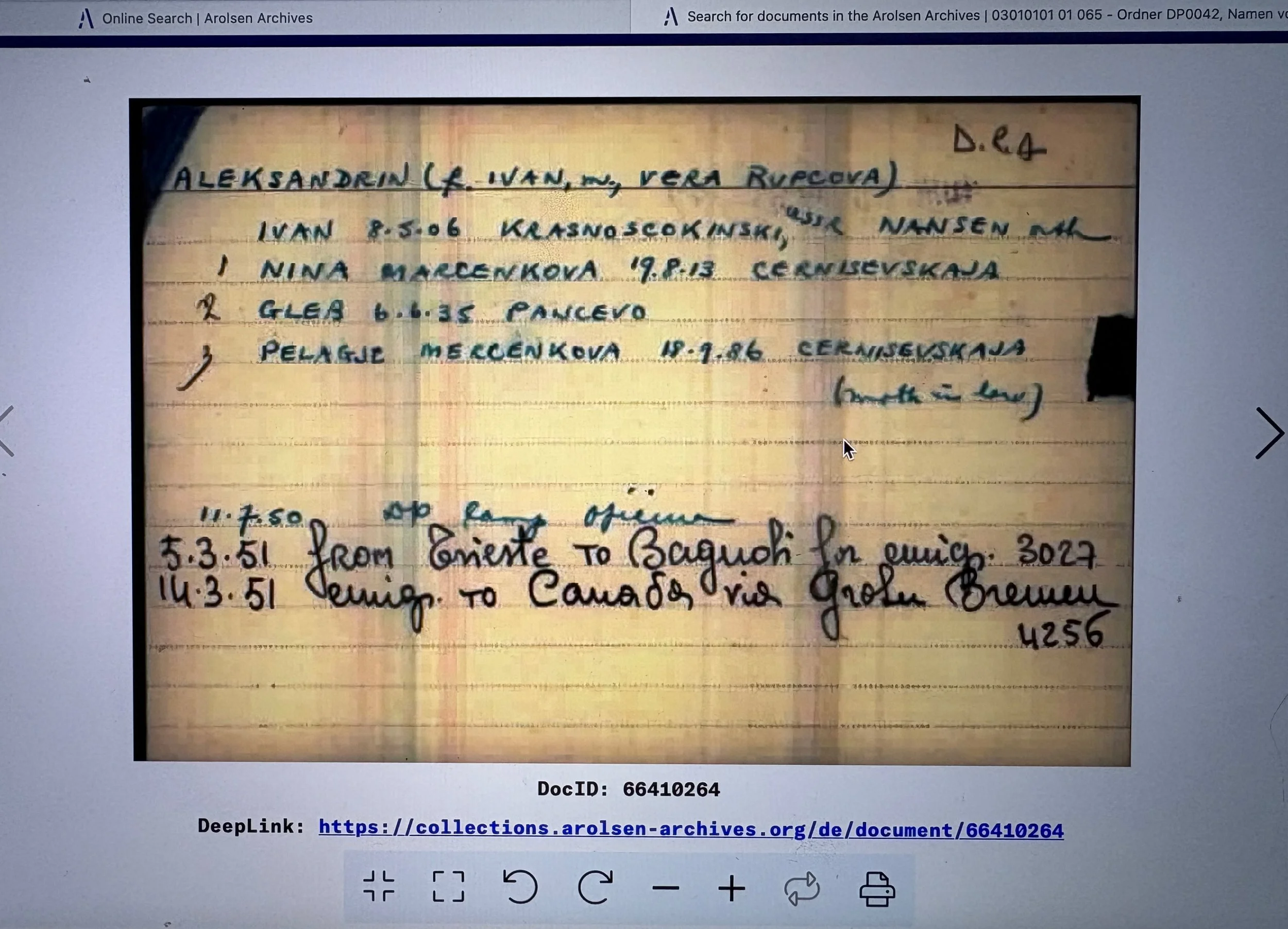
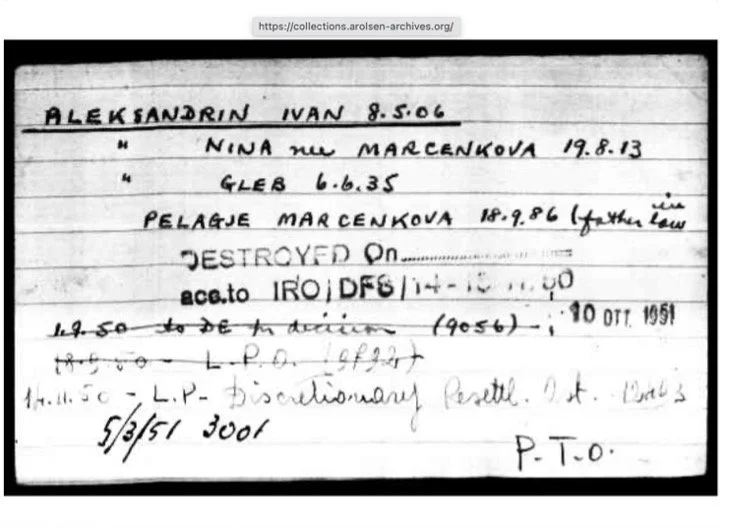
Record Two, archived in 1953, is about my dad's family, giving their places of birth, and recording their movement from Trieste to Germany and Canada.
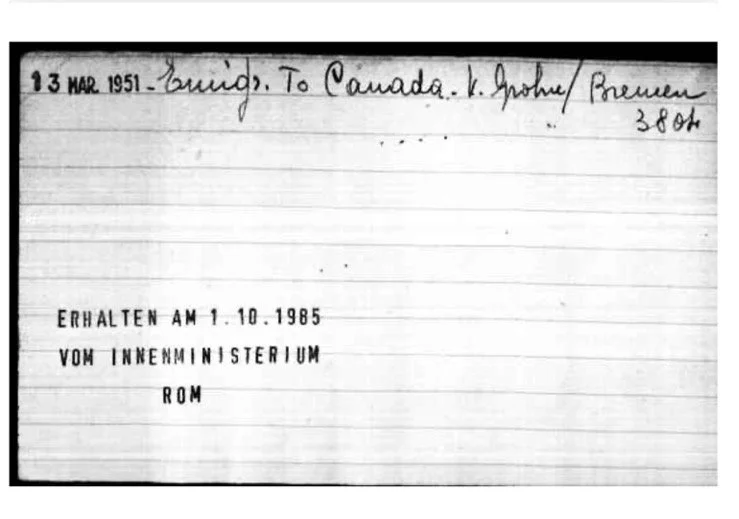
Another card was archived in 1985, when it was released from the Ministry of the Interior office in Rome. These two notecards suggest something I always suspected and feared was true. My grandfather left behind his other wife and their young son when he rushed to save my dad. That's how I know we were always great liars and great traitors and we were always on the wrong side of history. This must be the reason why we were sent away again.
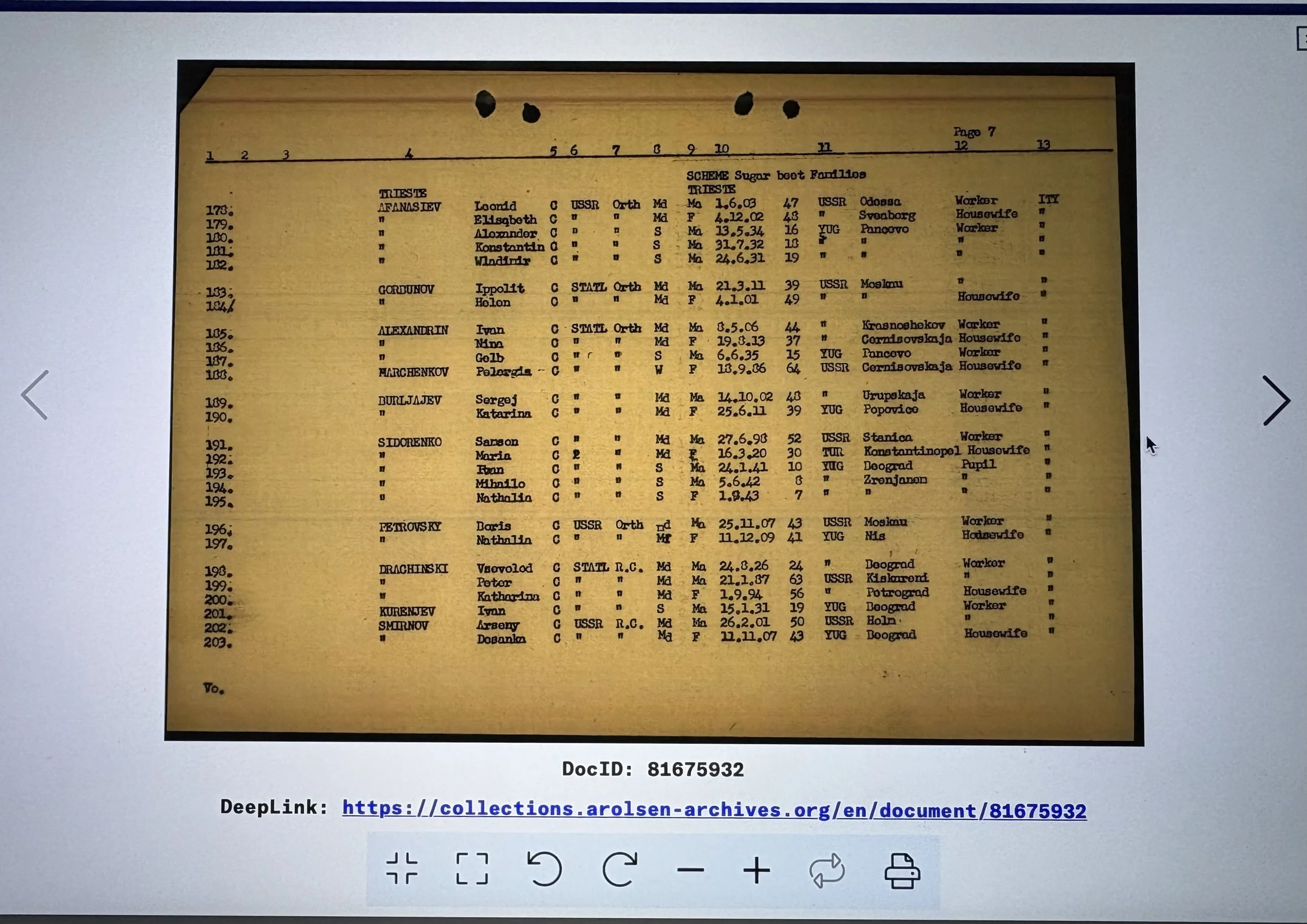
Here we are one of the “Sugar Beet Families.”
I still haven't found out why my dad's family was deported from Socialist Federal Republic Yugoslavia. I remain convinced that a horrible crime must have been committed, because there must be a reason why it all happened. But who committed the crime? Was it my grandfather?
Right after finding my family's names in Arsolen archive, I read the obituary of my dad's childhood friend from Sarajevo in the Winnipeg Free Press. They worked together on the sugar beet farms when they first came to Canada. His friend's obituary broke my heart too much. It sounded like what my dad used to say about the bad times that came. It reminded me of the conversations I had with my dad when he was in his nursing home, and we tried to speak in kitchen Bosnian.
But I like to remember how, during those conversations, many of his earliest memories returned, like the very sweet and small cherries he would pick off the trees and eat, going down the street, on the way home from the bus stop, when he was very young. This is the very same bus stop and street I went to see in Pančevo, in 2013, for my dad so I could come back and tell him of what I saw, and pray for all our dead, like he asked me, and as I promised.
This story is getting much too long. Since this is my dad's story, please let me share one more thing I think he would like the most.
Did you know, my dad loved Kalmyk burzeky most of all? It’s that small braided, fried bread, served at weddings, special events, given as offerings in Buddhist ceremonies, and eaten after prayers at funerals. He loved to eat it as a special treat, with tea, as a remembrance of the past, when all our families were once together. On other special occasions, he loved most to eat mille feuille and Italian pastries. He would never eat pasta—especially pasta e fagioli—which was served twice a day in the Trieste DP camp.
May we all live long lives and never have to put our hands out to ask for a piece of bread.