Sleeping Beauty
Lejla Talić

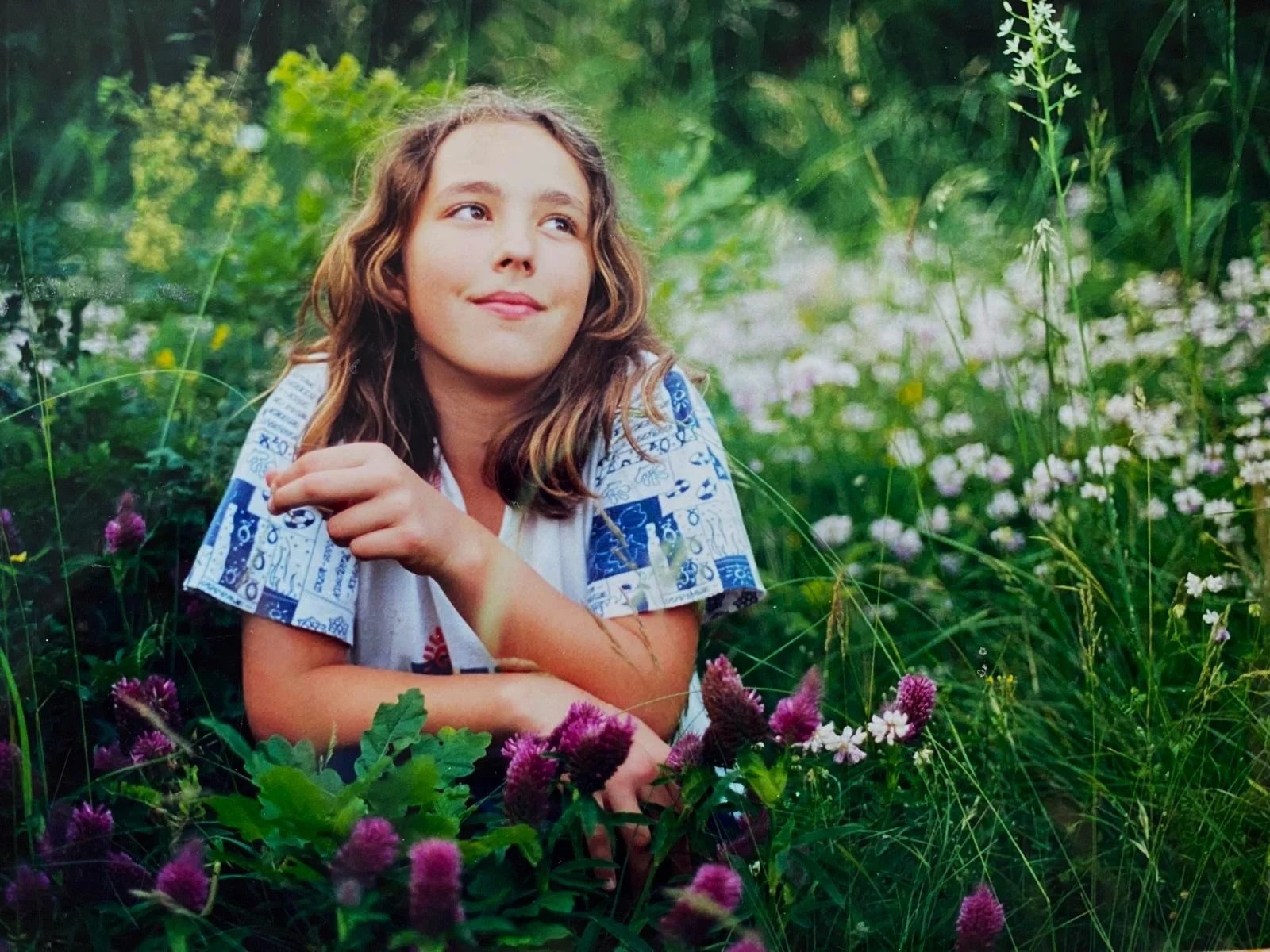
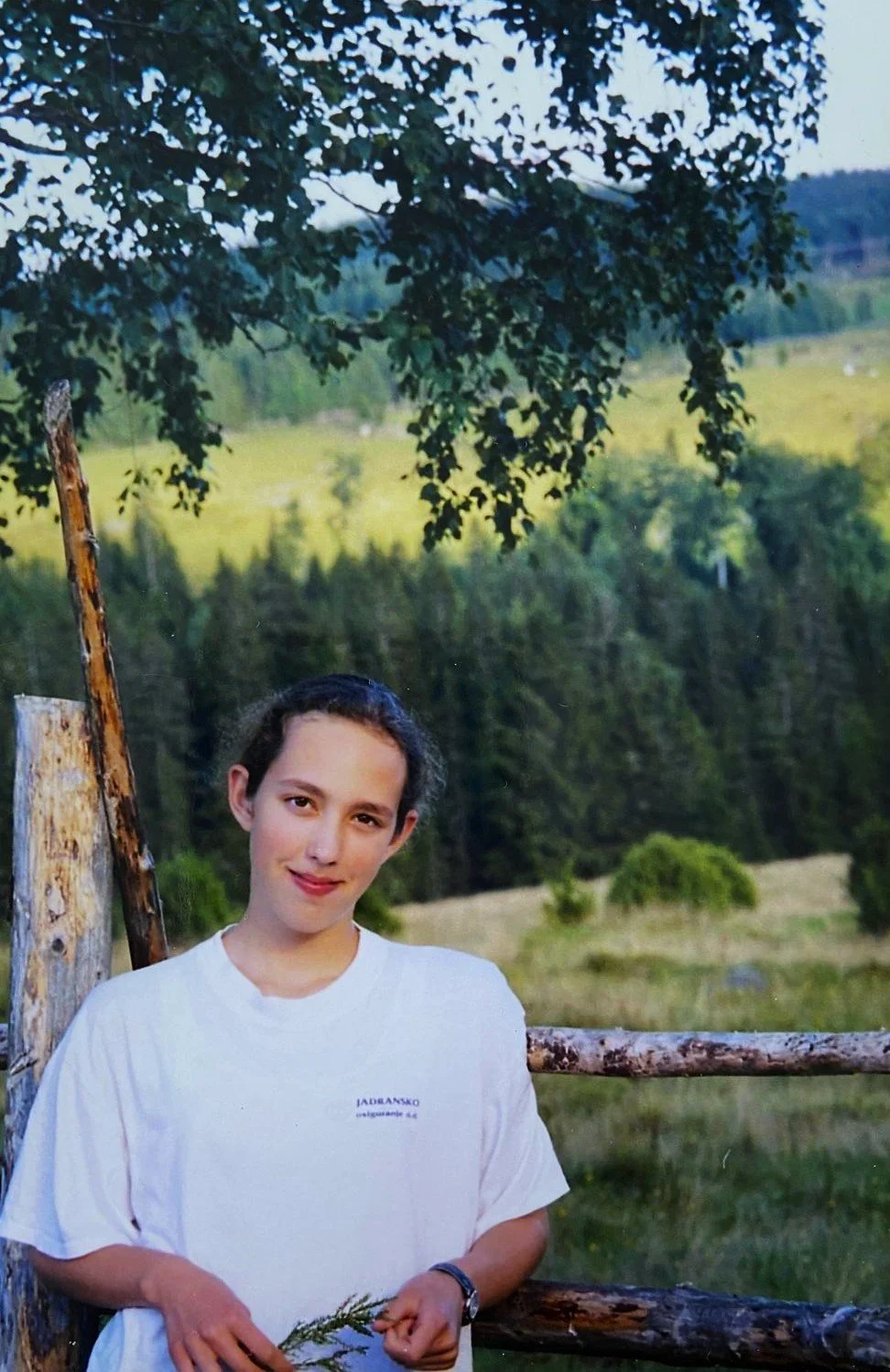
Sometimes, when I go back home to Split, I watch the old tapes of my sister and me as children. It’s a ritual my mother and my partner adore. We connect the old VHS, put in a random tape, and go back in time. My parents filmed everything; the most mundane, wonderful days of my childhood are always there for me to revisit, curated moments unmarred by imprecision of memory. There I am, singing and twirling and exclaiming precocious things to my father as he films, preserved on tape for reevaluation. The older I am, the more I see. So, I watch again, learning anew about who I was and who I might become.
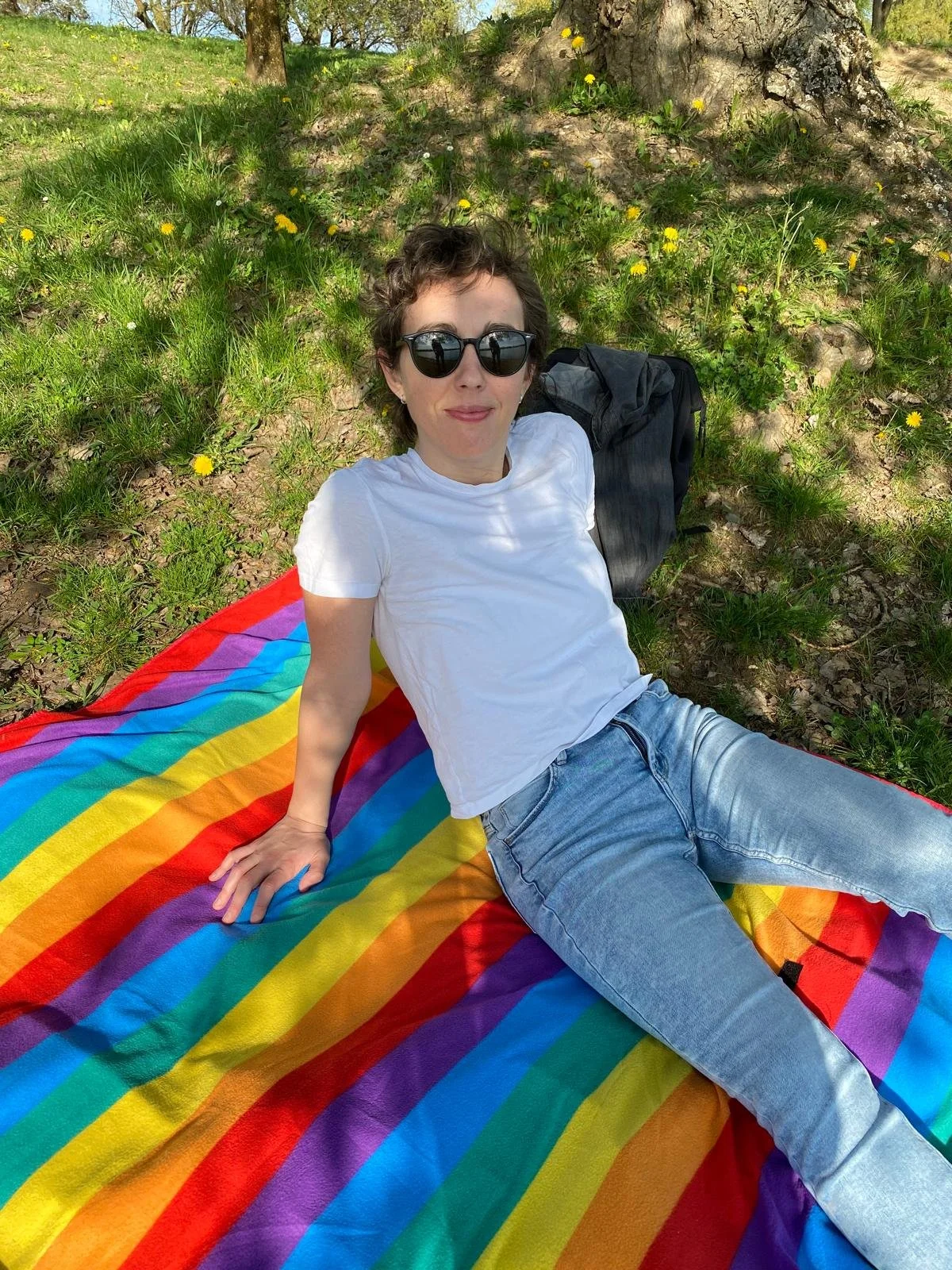
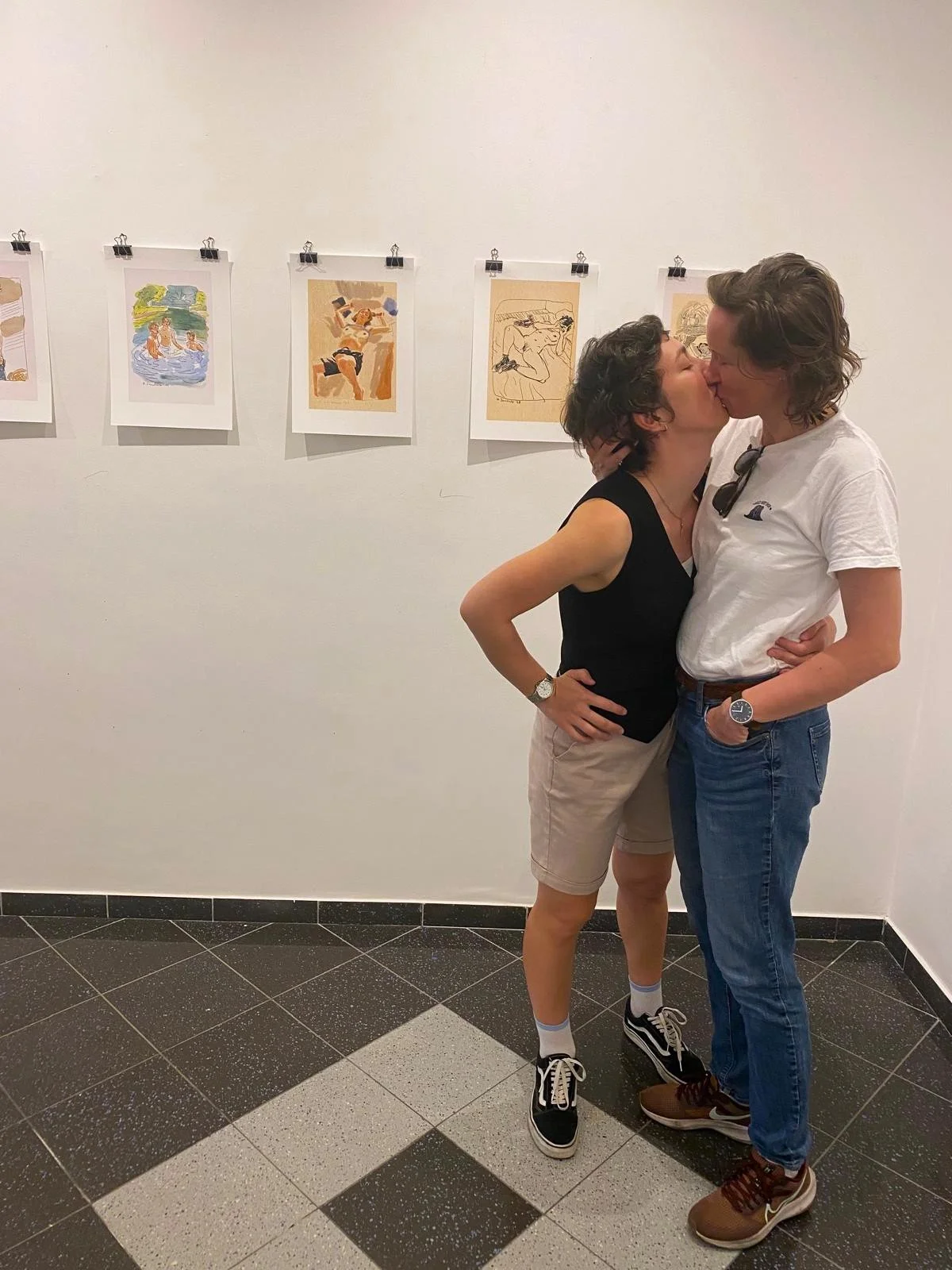
There is a video of me watching The Little Mermaid on TV, sitting still on the fraying couch in our old living room, mesmerized, with nothing but awe and adoration on my face. When Ariel sings, I suddenly yell at the screen “I am her!” From the vantage point of the present, the meaning of awe on my face is clear. I see it in the photographs of my partner and me; I look at Helena the way I looked at Ariel. Back then, my parents were only vaguely concerned and carefully rationed cartoons.
I was seven when I became aware of my longing for beautiful girls. All princesses fascinated me, but one stood out even more than Ariel. She was a beautiful blond girl on the kitchen towel my grandmother had placed above the stove, just out of my reach. It was just a dish cloth, but I couldn’t look away. “Please can I have her,” I would ask my grandmother whenever I went upstairs. Grandma would laugh and say “no” as she had already done so many times.
The girl was sleeping next to a spinning wheel, and my body tingled with a desperate longing to hold her close.

I grew up in postwar Croatia during the 1990s and early 2000s. My family’s relationship to sex was as bad as any other Balkan family’s. Sex seemed to be everywhere—in magazines, on TV, in the cinema—except in our lives.
There was something strange about the way no one ever talked about sex even though ours was a highly verbal family. We lived together in a multi-generational house close to the sea in Split: my grandparents, my uncle and aunt, my parents, my younger sister, and I. Every Saturday, we gathered in my grandparents’ apartment for coffee. Without exception, the ritual quickly turned into a discussion about politics, philosophy, and natural history. Their conversations steered clear of subjects of emotions, eroticism, or sex. Not hearing them talk about it meant that I could never truly understand what was happening to me. They talked at length about colonization of New Zealand and the politics of the Middle East, but never about anything that would help me make sense of the yearnings circulating in my body. I believed I was different in a very wrong way. I began to fear my body and its desires.
I barely ever witnessed physical touch and closeness between my parents or grandparents. There was such distance between them that I wondered how it was possible for there to be so little passion in such a beautiful house with a lush garden that flowered year-round. At twelve, this dissonance reached a fever pitch in my body, and something shifted in my perception.
“If you wear this, the kids will make fun of you,” my grandma tells me one morning before school after barging into my room. I just put on an orange shirt with purple cargo pants. She is on her way to the store, so we leave the house together. Her comments hurt, but I’m worried that she’s right. The girls made fun of me yesterday for wearing a tracksuit to school. Some of them called me a nun, some a nerd, some called me muškarača, and some said I was too weird to be around.
The air is crisp and smells of thyme and tangerines, but my stomach is turning and I’m sweating. Grandma is wearing a navy suit, sunglasses, and holding a shiny dark clutch. Her shirt is ironed to perfection, cream against her rosy cheeks. A faux pearl necklace hides the scar from thyroid surgery. She looks like she is going to the opera, not the butcher. She tells me not to walk like a cowboy, and I really, really try—but in vain.
Changing my clothes didn’t help this morning. Mia says I look cheap, Branka says I am too boring to talk to, and Nika just rolls her eyes. Boys I don’t look at, and they don’t look at me. I am not sure I could name all of them even though we have been in the same class for the past six years. But I could paint the face of every one of those horrible, beautiful girls.
I drag myself home from school, dreading the afternoon track practice. It’s early autumn, so the garden is changing colors, vine leaves turning into passionate red hearts. Lemons are big and dark green, but beginning to turn lighter with the coming winter. I decide to skip lunch and just eat oranges. I have decided to become a vegetarian. I have decided to run even more. I have decided to think only of school and grades. The fatness of my legs is my biggest worry. Well, that, and that I might be gay.
Later that evening, mom and grandma sit down together to watch You Rang, M’Lord. I don’t want to practice math, so I join them, even though the show is incomprehensibly boring. Then, just as I am about to return to math, Cissy appears on the screen dressed in a tuxedo, with short hair and wearing a monocle, and I can no longer look away. “Lezbača,” grandma says. In a rare show of agreement, my mother nods. There they sit together, united in their dislike of an imaginary woman.
My mother and grandmother have nothing in common. They don’t even look like they are related. You’d have to look really close to see that their shoulders all come from a similar place. You’d have to look inside, into their thyroids; my grandma’s almost completely gone, my mother’s eating itself slowly without her knowledge. My mom has short hair, wears glasses and overalls, oversized plaid shirts and decades-old jeans, like a butch lesbian. My grandmother is in full garb even when she goes out to throw out the trash. My mother is incapable of cooking even the simplest dish without messing it up, resulting in saltless rice, overcooked tofu, and my father’s wrath. My grandmother cooks a three-course meal every day for all of us, Slavonian dishes with a Mediterranean flair. My mom is short, while my grandma is tall and strong, her presence filling every room. My mom always has her hands in the flower beds, with dirt under her nails, using only organic pesticides and hand-picking beetles off plants. Her clothes and short hair are an ongoing subject of discussion and my grandma’s disapproval. “What will people say.”
The show continues. My mom sips her drink, grimacing. She is on her third diet this year; the cabbage soup solution. She is a victim of early nineties social conditioning, hypoactive thyroid, and my father’s relentless criticism. One of my earliest memories is of my sister and me sitting on mom’s legs as she does crunches. I thought she was the most beautiful woman in the world and couldn’t understand why she hated her body so much. At twelve I understood all too well.
Now it’s my turn to take up her mantle, but I have to take it further. I run myself to the bone, eat plain millet for lunch and nothing else. I loathe my broad, masculine shoulders, and my wavy, springy hair, both a clear gift from my grandma, the only physical resemblance we share. Other than that, I am a spitting image of my mother and grandfather, Dalmatian through and through, if not for those alpine shoulders. At twelve, the only resemblance I have to my father are my long, masculine flat-topped fingers, and invisible inclinations beneath my skin. Grandma hates my new culinary independence. My mother supports it. I am torn between them, my body a battlefield of their wills.
But they agree on this one thing: they hate sex. And female breasts. My grandmother can’t stand them. Whenever we watch a film together, she has a meltdown at the sight of female nudity. Twitching in her chair, she declares the women obscene and movies degenerate. I avoid watching films with her even though this has been our favorite thing to do together. Now I am embarrassed, and I don’t even know why.
My relationship with breasts couldn’t be more different. Since any kind of self-pleasuring was unthinkable in a house like ours, with no locks on any of the doors except on my grandmother’s bathroom, I first experienced the strange pleasure of touching my nipples with a cold object. I can’t look away when I see women’s breasts in magazines, books, or on TV, warmth that I can’t explain spreading through my body. I loathe myself for feeling like this and suspect I am deranged.
I got my period that spring, on my mother’s forty-second birthday. I hid it from her for days. I stuffed toilet paper in my underwear and went running, hoping it would disappear. My entire body trembled when I walked up to her to give her the news. An unknown feeling constricted my throat. I could barely speak. “I got my period,” I said. “No, you didn’t,” she replied. It was an unexpected yet familiar conversation. Anything to do with sex or intimate parts of our bodies made my mother speak in a different voice. My warm mother disappeared, and a stranger emerged. She forbade me from washing my body and hair or swimming in the sea. Any new feeling I tried to express was called “hormones” and dismissed.
I knew better than to believe her, so I hightailed it to the library. The foreign books with cheerful covers said very different things. They said we were allowed to take baths and swim when on a period. It was, in fact, recommended. My mother quickly lost credibility as I read book after book on teenage health and sexuality. Embarrassment turned to rage, which had nowhere to go, so I swallowed it down, and starved, too full of these unnamable feelings.
I ran so much that I lost all the fat tissue needed for a girl of twelve to have period. I became flat and agile, and I liked my body that way. I wanted to remain a child, watching movies with my grandma without understanding, eating cakes without guilt, and thinking girls were beautiful without that changing anything about me.
My yearnings had become too much so I left them in the sea that summer. I buried them deep in the sand at the beach. I swallowed them down with the first cherries, the only food I allowed myself to eat. I ran from them and prayed them away even though nobody in my family was religious.
By my thirteenth birthday I had forgotten I had ever thought I was gay. That was the year the first Pride was held in Croatia, the first ever in any post-Yugoslav country. It was met with a violent backlash, a news item my grandmother and mother had surely seen on TV but never spoke about.
My first love story began in November when I was fifteen. It ended one year later, with me in the hospital.
I noticed Mila in the main hall even before we were assigned to the same class. She looked like Aurora from the Sleeping Beauty, all high cheek bones and honey blond hair, eyes dark and piercing. She wore tight jeans with Jim Morrison and Sex Pistols patches on her back pockets and moved like she commanded the will of every person in her presence.
I knew she would hurt me even before she spoke to me the first time. “I love your name,” she said and whirled away leaving me red and flustered. My name had always been a reminder of my strangeness, not Croatian enough. I had been relentlessly bullied for it, and I had wished for a less obviously Muslim name. But once Mila said it was beautiful, I could see the beauty of it too. She thought I had been named for Eric Clapton’s song, and I never corrected her.
I tried to listen to the warning alarms in my head , but it was impossible to stay away from Mila. We were in the same class. We had the same interests. Soon enough, I could think about nothing but her. My dreams of science were over; she introduced me to literature and art, we discussed poetry, we lay in the sun and talked about His Dark Materials for hours. When choosing what to wear to school, I only thought of her approval. When choosing what to read, watch, or even say, I always thought of her. I walked halfway across town in the wrong direction just to share a ride on the same bus with her. I told her everything. She told me everything.
The unnamable longing now found its focal point in her. My body burned for her presence and attention. I didn’t have a name for it. But I would have gladly died for her, as I guess all teenagers would when they fall in love for the first time. I forgot that girls can love girls. I forgot that I had named it once and then buried it as deep as I could. Turns out I had made a shallow grave for the truth, and it began its slow resurgence.
Mila introduced me to cafes and secret passages in the old Palace, streets that spiraled into forest where we rode our bicycles and lay in the spring afternoons, daisies blooming in our hair, holding hands and making promises. With Mila, I could eat anything, ice cream, pizza, whatever she wanted. My body changed, bones sinking back below the skin. A force grew within me, closer to the surface of my understanding. I had breasts. I had period. My body was making up for lost time.
The end of the school year was fast approaching, and I was almost close to knowing. One late morning, alone at home, as I was getting dressed, a Blink-182 song came on MTV. I Miss You. A scene of two girls kissing in a dark forest burned my eyes, and my body dissolved around me. I felt like I had warm sunlight for limbs. My chest was pounding fiercely. Then I looked at my phone and saw a message from Mila. It said not to come.
In school, she wouldn’t talk to me. I couldn’t grasp what had happened. Hadn’t she taken my hands and spun me around on the slippery cobblestones in the old town just yesterday? Mila disappeared just as she had appeared, suddenly and completely. She had a new best friend, and I was just a stranger. She said I had become too attached.
Nothing could have prepared me for the heartache of an unnamed first love. My parents were confused. Even my grandmother tried to talk to me. She made me a skirt. Her fingers aching from arthritis, she still tried to make something beautiful for me. It was indigo-colored, and it became loose around my waist in a little over a month. The force that bloomed inside me withered and retreated, taking all of me with it.
In the hospital, in January, the psychiatrist asked about my family. I barely said anything before he concluded that, because my great-grandmother had abandoned my grandmother, my grandmother was cold to my mother, and my mother in turn was ambivalent to me. A neat Freudian story. It’s always the mother’s fault. Nothing made sense, though. My grandmother wasn’t cold. My mother wasn’t ambivalent. The psychiatrist said I was refusing the proper role of a woman. I guess I was. One of the biggest joys of my sick years was being mistaken for a boy. My hair had been falling out so much that I cut it off completely, and looked like a masc lesbian, only a very pale, sick one.
My mother was blamed for creating gender confusion in me by dressing in an unfeminine manner and refusing to cook. My father’s starched shirts, polished shoes, and perfect manners were never questioned. No one doubted his gender identity, even though he sang, cooked, and dealt with my bras, my period, and my body hair far better than my mother ever did. No one ever doubted his conservatism, his rigidity, or the way he treated my mother, no one even mentioned genetics, even though my paternal aunt had almost died of anorexia.
Mila came back two years later, when I was almost finished with high school. I had dragged myself through years of bad therapy and perfunctory attempts at recovery, my body somewhere at the edge of health. One frigid October evening, just as I was about to go home, she stopped me and asked whether I wanted to go see a film. I knew what I was supposed to say. I had practiced it so many times in my head. Why did I say yes instead? I know now, but did I know then? I knew, without knowing, a strange sinking feeling. We started seeing each other all the time again. I went to her before school. We skipped classes together. Our conversations ran deeper, the hours ran longer, no curfews since we were both eighteen. The truth was kept at bay by the chemistry of my body, but barely.
Mila had been angling for a new boyfriend, and I kept getting inexplicably angry, and then angry at myself for getting angry. My lungs once again hurt from rushing to her any chance I had, and I knew that if I didn’t do something different, history would repeat itself. So, I went out with some acquaintances. I had never tried drinking alcohol before, but I drank. I blacked out immediately. He promised he would take me home, but of course, he didn’t.
I woke up to blood on my white underwear. It wasn’t period; I was still too thin. It was the torn flesh of my insides, ravaged by his fingers. Just fingers can destroy your entire soul. I went about my day as if nothing had happened. I got dressed. I had coffee with soymilk, still vegan.
I went upstairs to grandma. It was just the two of us in the big empty house. “Grandma, I am here,” I yelled, because her hearing had been getting weaker. She was sitting in my grandfather’s big chair and smiled at me. “Darling, so good that you are here!” She became kinder with age. It never occurred to me to talk to her about what had happened the night before. I was already becoming a stranger to the girl I had been just ten hours ago. Nothing had happened, just blood flowing down my legs.
“Are you hungry,” she asked. I wanted to scream that I was starved—for truth beauty for love. That I am completely crazy, out of my mind, that I am not really here, that I am torn and so little is left, only the part that longs and waits. I smiled instead and lied that I had already had breakfast. Grandma stood in the kitchen, making peas. The beautiful girl was still sleeping above the stove, untouched, and I’d have given anything to be transported into her serene world.
Why didn’t I tell Mila? I tried, but words got stuck in my throat. I didn’t want to lose her too soon, even though I knew I eventually would. Every time I looked at her, I tried to ready myself for the moment when I would have to let her go. She told me we would be roommates when we moved to Zagreb. She promised we’d travel across Europe come summer. I knew we wouldn’t.
I was still seeing a therapist at the time, a renowned middle-aged woman, who charged exorbitantly. Every week I put my trust in her hands, believing she knew how to help me. A week before the bad thing happened, I had confessed that I was hanging out with Mila again.
The therapist looked exasperated. She said that homosexual relationships were an immature part of relational development, alluding to my preoccupation with Mila, and that the mature developmental goal for girls was to be with boys. I then told her about a dream in which a boy shot me with a gun and left me bleeding, but she said that the dream meant that I crave a penis. I told her nothing about what had happened to me.
When I left for Zagreb to study psychology, my grandmother cried with joy. She was so proud. She gave me two gifts. A photo album containing my childhood photographs and the kitchen towel with the blond Sleeping Beauty wrapped carefully in cellophane. I held my breath seeing that face I had wanted for so long. Now that she was finally in my hands, we had never been further apart.
I left the Sleeping Beauty unwrapped in a box of keepsakes, together with the birthday cards my grandmother had given me over the years, old concert tickets, souvenirs from places I barely remembered. She moved with me, safely wrapped just as she had been when I left home, from one rundown apartment to the next, in a box I never opened.
I saw Mila only once in Zagreb. We were in a nightclub. She danced surrounded by boys. I looked straight into her eyes and then chose to look away.
When I think of the years that followed, I feel like I am sifting through someone else’s memories. I graduated, I recovered, I started working as a psychologist, all the while wearing a veneer of femininity and heterosexuality—red lipstick, high heels, skirts, long hair. A mask.
There was no magic in figuring out I was a lesbian.
Maybe I finally remembered the truth because I was physically healthy but endlessly sad. My life was picture perfect, but I was miserable nevertheless. Maybe the therapy had finally kicked in. Maybe it was because I was working as a school psychologist, facing adolescents daily, their unwavering longing for the truth and absolute intolerance for inauthenticity. I created a safe place for my students to talk about their secrets, fought for them, and talked to them about things I wished someone had explained to me at their age. Maybe it was all those things weaving a new picture, an entirely new perspective of my life. Slowly, and then all at once, memories started coming back in dreams and flashes, and then one day I remembered everything and fell in love with a woman.
A second adolescence in your thirties means the stakes are infinitely higher, the dangers much greater, and you can’t call your parents to pick you up from the club when you’ve made a terrible mistake. I moved seven times in three years. I kissed a woman, had sex with her, left, and started again. All the buried feelings came back like an unending flood, dysregulated, overwhelmed, and mine, all mine.
I grieved for the lost years, and I suspect I always will.
Whenever the grief becomes too much, I gently go back to all the girls I used to be and tell them that I will always be coming back for them: the terrified twelve-year-old who buried herself in prayers and ran from the truth so hard she lost her mind; the lovesick fifteen-year-old who couldn’t name the love that broke her life into the before and after, so she starved it away; the wounded eighteen-year-old who fell into a Sleeping Beauty slumber, waiting for her princess to release her. I love all of them.
Another autumn in Zagreb, so many years later, no golden leaves, no red hearts on the pavement, just deep fog across the river and the lake. It muffles sounds and my footsteps. I open the door, I climb the stairs, and fall into my love’s arms, exhausted after a long day. This is my life now, I remind the fearful girls in my heart who brace for all of it to be taken away, counting the kisses before they disappear.
I finally open the box of keepsakes. I take out my grandmother’s gift. The cloth still smells like countless seasons of cooking, old grease, and home. The girl is here, just as beautiful as she was thirty years ago. She’s mine, I know her and I know myself. I look at her and then at Helena, who smiles and moves closer to kiss me, her arms warm and safe around me.