Mileva's Singer Machine
Dragica Mikavica
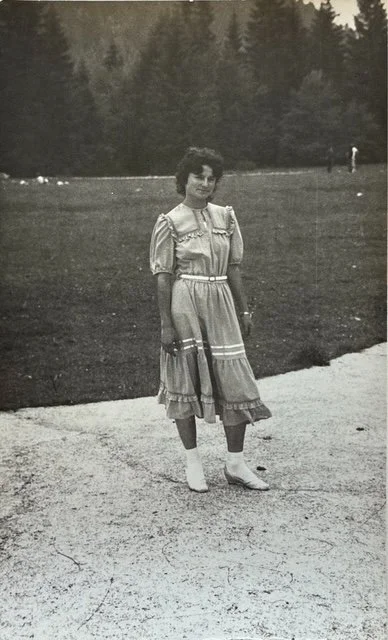
Photo: Dragica Mikavica’s family archive
When the soldiers arrived at my maternal grandparents’ house, they stripped it down to its bare walls. Only the heaviest and the seemingly most useless object remained: my grandmother’s old-fashioned Singer machine—“Singerica”—with a cast iron base, a pedal, and a wheel to the side. To those who were picking and packing, Singerica was a nuisance to steal. To me, as I sew up a small piece of my family’s past three decades later, it’s priceless.
After the war, my uncle Mile was the first to return to the house my grandparents built from scratch in my hometown Glamoč, Bosnia. There, he encountered the lone Singer, loaded it up with the permission of the house’s new occupants, and brought it to Serbia. There it sits today, unused for its original purpose—now considered a lost skill. Instead, the machine accrues memories of our shared past, occupying space for sentimental value.
In a later telling of her story, my grandmother Mileva was the last remaining person on her street at the end of the war, frightened out of her mind from shelling. Before leaving, she said, she had handed bags of clothes and blankets to a neighbor passing by with a tractor to carry out of Bosnia with him.

Coming up from the subway station in Greenpoint, New York, on a recent day, I encountered a ghost from the past on a newsstand: Polish edition of the Burda magazine. Seeing its cover page triggered my earliest memories of my mom’s sewing patterns from Burda’s Yugoslav version spread out on the bedroom floor. A mere sight of it brought me so much joy that a few months later, I enrolled in a sewing class out of nostalgia for my childhood in Glamoč before the war. Sewing thus came to play a small part in my continuous healing journey. Growing up, my mom Marica learned how to sew on Mileva’s Singer and she loved it. She bought her own sewing machine when she got married, and it became her hobby as a stay-at-home mom.
Appreciating their sentimental value and unique design, I asked my aunt Milkica to borrow her high school teal blue dress and her red knit sweater I saw in the family pictures taken in the ‘80s. I asked my aunt and mom, “why did grandma send these particular items currently hanging in my closet in Queens?” My aunt had envisioned a sweater in red with a particular type of yarn, and Mileva knitted it for her when my aunt was pregnant with her first child. Grandma sensed that these garments might be valuable to my aunt, and she packed them for her. Aunt had already escaped Bosnia as women with children in my family had done towards the end of the war, including my mom.
I thought of my mom, aunts, and grandmothers when I read Slavenka Drakulić’s book, How We Survived Communism and Even Laughed about the resourcefulness and tenacity of women living in socialist Eastern European republics, including Yugoslavia, when it came to beauty, hygiene, and survival. I read this book in a college modern European history class, and it put into words what I had already witnessed throughout my life. Women I grew up with, too, would stop a run in their nylon stockings with a touch of old nail polish.
Mom and aunt told me that it was common in Yugoslavia for women to sew their own clothes, but in my grandmother’s youth, it was rare for someone to own a Singer where they lived. It turns out that it was purchased for her by my great-grandfather Stevo as a dowry gift. At the time, the Singer was a symbol of wealth. Two generations later, I find myself living in New York City, the birthplace of the Singer machine factory. The Singer first established luxury dealerships in the Kingdom of Yugoslavia in 1926. I imagine that Mileva’s model could have originated at that time.
While my mother was growing up, Mileva had apparently sown onesies for her and her three siblings on the Singer machine. To keep up with their growth spurts, she would cut off the bottoms where the feet were to extend the onesies’ life. Fabric could be bought in one of the three stores in town. The life of everything they owned was extended for as long as possible. Regardless of any imports or store supplies available in Glamoč at the time, which was small and remote, they could always buy fabric.
From their stories, I realized that the Singer, beyond helping with the alterations of a growing family, became the center point for the neighborhood women who brought Mileva items to mend or fabrics to sew new clothes. It must have given her great importance. She designed, too. Aunt remembers a tiered skirt grandma made from white cloth diapers tie-dyed yellow and a shoulder bag made from denim jeans.
In their adolescence, my mom and her siblings had about two to three changes of clothes. Variety came from swapping clothes and shoes amongst friends. They could not afford more than that on grandfather’s salary, but they said they were always clean and dignified. My aunt said this about their early years in Yugoslavia: “Times were happier; people were more mature, satisfied, and rational when it came to their possessions.” They did not feel that they were lacking. If it were possible to travel back into that impossible time before the war, my mom Marica wishes she could still have a long blue, button-down, belted winter coat with a wide collar she loved, perhaps made by Beko or some other Yugoslav brand. It was purchased on a trip to Banja Luka, the nearest big city to Glamoč.
During the war, they each had a ready bag with their and their kids’ clothes, shoes, and family photos. Fleeing to the village for shelter on occasion, they brought those emergency bags with them. However, they always thought it was temporary. They always thought they would come back. For four years, they picked scraps of cotton fabric to use in place of period pads. They had to improvise, just as they did with one kilogram of salt, flour, and detergent per family dropped off by Red Cross trucks. To me, not yet ten years old at the time, it could not have occurred to consider what women did for hygiene during wartime. I only thought about it at thirteen when, a refugee in Serbia, I got my first period, and the first sanitary pads I used arrived from UNHCR, half an inch thick and uncomfortable, another affront to our body and dignity. I only vaguely recall the oversized pots filled with fabrics boiled and starched on the oven fired by wood in our home during the war.
Suddenly, I saw a pattern. The women in my family cared about living a life of dignity. But the years of living as refugees in Serbia were the most undignified.
With most of our belongings left behind, during the first winter in Serbia, my mom had no coat and had to ask to borrow one from her uncle’s daughter. When I walked to school on an unpaved road from a house on Sava River we settled in, the rain and mud spattered the hems of my donated jeans. As a teenager already, I was ashamed of getting to school like this and hoped for a life where I would again be able to have my own clothes and we would not have to receive hand-me-downs.
The first garment I sewed after learning how to use a machine was a classic skirt I created from patterned fabric that traveled back with me from a work assignment in Africa. As I sit at my own sewing machine in Queens threading red thread through its needle, not unlike that of my aunt’s knit sweater I now wear, I see my late grandmother pedaling the old Singerica, a comforting sound of my unspoiled childhood. I reflect upon the fabrics that held our bodies, our blood, and our memories, in newfound dignity.